You overdraw your checking account by a few dollars and get hit with a $35 fee. Annoying, but you pay it and move on. What you may not realize is that by accepting the account terms, you likely signed away your right to sue the bank over that fee—or any other dispute—in court. Instead, you agreed to resolve all claims through private arbitration, and you gave up the ability to join a class action. This is not a hypothetical risk. It is a standard feature of many checking account agreements, and it costs consumers far more than the fee itself.
The Fine Print That Binds: How a $35 Fee Can Cost You Your Day in Court
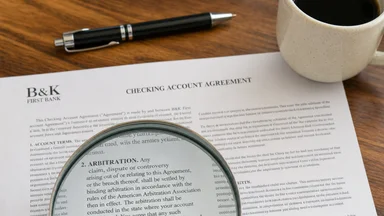
When you open a checking account, the bank hands you a thick booklet of terms and conditions. Buried somewhere in that document—often under a heading like "Dispute Resolution" or "Arbitration Agreement"—is a clause that requires you to resolve any disputes through binding individual arbitration. It also typically prohibits you from participating in a class-action lawsuit. This means that even if the bank charged thousands of customers an improper fee, you cannot band together to sue. Each person must pursue their own claim in a private forum that favors the repeat-player institution.
The Consumer Financial Protection Bureau (CFPB) has documented the prevalence of these clauses. A 2023 CFPB study found that roughly 60% of large banks include mandatory arbitration clauses in their consumer account agreements. The same study noted that these clauses overwhelmingly include class-action waivers. For a product as basic as a checking account, the fine print can strip away a fundamental legal right.
The typical overdraft fee is around $35 per occurrence. Some banks also charge a sustained overdraft fee if the account remains negative for a few days. These fees can pile up quickly. But the larger cost is the loss of legal recourse. If a bank engages in a pattern of charging unlawful fees—say, processing transactions in a high-to-low order to maximize overdrafts—individual arbitration makes it impractical for most customers to challenge the practice. The cost of hiring a lawyer and navigating arbitration often exceeds the potential recovery.
Anatomy of an Overdraft: Where the Fee Hides and Why It Matters
An overdraft occurs when a transaction exceeds the available balance in your checking account. If you have opted in for overdraft coverage on debit card transactions, the bank may authorize the payment and then charge a fee. If you have not opted in, the transaction is simply declined. But for checks and automatic bill payments, banks often cover the overdraft and charge a fee regardless of opt-in status.
The fee structure is typically a flat amount per transaction, with no cap on the number of fees per day. Some banks charge up to three or four overdraft fees in a single day. According to data from the CFPB, the median overdraft fee was $30 in 2025, and the average annual cost for frequent overdrafters—those who incur more than 10 fees per year—exceeds $200. For lower-income account holders, these fees can represent a significant portion of their monthly budget.
The real sting is that the fee triggers the arbitration clause. When you accept the account terms, you agree to the dispute resolution process. Overdraft fees are a common source of consumer disputes, and banks have a strong incentive to keep those disputes out of court. By tying the fee to a mandatory arbitration clause, banks effectively insulate themselves from class-action liability over the very fees that generate billions in revenue each year.
The Arbitration Trap: How Banks Shield Themselves from Lawsuits
Mandatory arbitration clauses are not new. They became widespread in consumer contracts after a series of Supreme Court decisions, most notably AT&T Mobility v. Concepcion (2011), which upheld the enforceability of class-action waivers in arbitration agreements. Since then, banks have included these clauses in checking account agreements with increasing frequency.
Arbitration is a private dispute resolution process that takes place outside of court. The arbitrator is often a retired judge or lawyer selected by a private arbitration company. The proceedings are confidential, and the arbitrator's decision is generally final and binding. Unlike a court case, there is no jury, limited discovery, and no formal appeals process. For a consumer with a small claim—say, a few hundred dollars in disputed fees—the cost of filing for arbitration can exceed the claim itself, making it economically irrational to pursue.
The asymmetry favors the bank. Banks are repeat players in arbitration; they know the process, the arbitrators, and the strategies. Consumers are typically one-time participants. The private nature of arbitration also means that patterns of misconduct never become public. A class-action lawsuit, by contrast, can expose widespread problems and lead to reforms that benefit all customers.
Regulatory Pushback and the 2026 Enforcement Landscape
Regulators have taken notice. In May 2026, the Federal Reserve Board issued enforcement actions against a former employee of Atlantic Union Bank and a former employee of Frost Bank for misconduct related to consumer accounts. While these actions targeted individuals, they signal that regulators are scrutinizing bank practices more closely. The CFPB has proposed a rule that would limit overdraft fees to a level that covers only the bank's actual costs, which could reduce fees from $35 to as little as $3. However, as of mid-2026, that rule has not been finalized.
At the state level, some legislatures have considered bills to ban forced arbitration in consumer contracts. California and New York have introduced such measures, but none have passed as of 2026. The banking industry has lobbied heavily against these efforts, arguing that arbitration reduces costs for consumers and speeds resolution. Consumer advocates counter that the current system is stacked against individuals.
The regulatory environment is shifting, but slowly. For now, the burden remains on the consumer to read the fine print and act to protect their rights.
Real-World Costs: Who Pays and How Much
The people most affected by overdraft fees are those who can least afford them. A 2024 study by the Center for Responsible Lending found that heavy overdraft users are disproportionately lower-income, younger, and more likely to be people of color. The median overdraft fee per incident was around $30 in 2025, according to CFPB data, and banks collectively earn billions annually from overdraft and nonsufficient funds (NSF) fees.
For a person living paycheck to paycheck, a single $35 overdraft fee can trigger a cascade of additional charges. If the account remains negative, the bank may charge a sustained overdraft fee after a few days. If a check bounces, the merchant may charge a returned-check fee. The total cost can quickly exceed $100 for a single mistake.
The arbitration clause adds a hidden cost. Even if the fee was charged in error, the consumer's only recourse is individual arbitration. Most people do not pursue arbitration because the time and expense outweigh the potential recovery. As a result, banks face little accountability for improper fees. A 2022 analysis by the CFPB found that fewer than 1% of consumers with arbitration clauses ever filed a claim.
Trade-Offs and Counter-Arguments: Is Arbitration All Bad?
Proponents of mandatory arbitration argue that it provides a faster, cheaper, and less formal alternative to litigation. They contend that court cases can drag on for years, cost tens of thousands of dollars in legal fees, and overwhelm the judicial system. Arbitration, they say, can resolve disputes in months, with lower costs for both parties. For example, the American Arbitration Association charges a consumer filing fee of $200 for claims under $75,000, which is less than a typical court filing fee. However, this still exceeds the value of many overdraft fee disputes. Moreover, the bank often pays the arbitrator's fees, which can run into the thousands, but only if the consumer wins—a condition that critics say discourages claims.
Another argument is that arbitration preserves privacy. In court, filings and hearings are public record. In arbitration, the proceedings are confidential, which can protect consumers from unwanted publicity. But this privacy also shields banks from public scrutiny. A class-action lawsuit against a bank for widespread overdraft fee abuses can generate media coverage and pressure for reform, whereas individual arbitration keeps each case isolated. Thus, the privacy benefit to consumers is offset by the lack of transparency for systemic issues.
Some banks also argue that arbitration clauses allow them to offer lower fees and better terms because they avoid the cost of defending class actions. For instance, a 2019 study by the Consumer Financial Protection Bureau found that some banks with arbitration clauses had lower average overdraft fees than those without. However, the same study noted that the difference was small—around $2 to $3—and that other factors, such as account features and marketing, could explain the variation. Consumer advocates counter that the savings, if any, are not passed on to consumers in a meaningful way, while the loss of legal rights is substantial.
Ultimately, the debate comes down to a trade-off: individual efficiency versus collective accountability. For a single consumer with a small claim, arbitration might be faster and cheaper than court. But for society as a whole, the inability to aggregate claims allows banks to continue practices that harm millions of customers. The CFPB's 2023 study found that between 2012 and 2022, only about 0.1% of consumers with arbitration clauses filed a claim, compared to 0.5% of consumers without such clauses who filed a lawsuit. This suggests that arbitration effectively deters consumers from seeking redress.
What You Can Do: Reading the Fine Print and Opting Out
Not all checking accounts include mandatory arbitration clauses, and even those that do often allow you to opt out within a certain window—typically 30 to 60 days after opening the account. The opt-out instructions are usually buried in the arbitration section of the account agreement. You must send a written notice to the bank stating that you reject the arbitration clause. Some banks require a specific form or mailing address, so read carefully.
If you already have an account with an arbitration clause, you may still be able to opt out if the bank amends its terms. Banks occasionally update their account agreements, and they often include a new opt-out period with each amendment. Watch for notices in the mail or in your online banking portal. If you miss the window, you are stuck with the clause unless you close the account.
Consider switching to a credit union or an online bank that does not include forced arbitration in its terms. Many credit unions have simpler fee structures and may not use arbitration clauses at all. Online banks like Ally and SoFi have publicly stated that they do not require arbitration for consumer accounts. Before opening any account, ask the bank directly: "Does your checking account agreement include a mandatory arbitration clause that waives my right to a class action?" If the answer is yes, and you cannot opt out, look elsewhere.
The Takeaway: A $35 Fee Can Waive Your Right to Sue — Know Before You Sign
The overdraft fee itself is a nuisance, but the legal cost is far larger. By agreeing to mandatory arbitration and a class-action waiver, you give up the most effective tool consumers have to hold banks accountable: collective action. Arbitration clauses are standard, but they are not mandatory—you can opt out if you act quickly. The regulatory environment is shifting, with the CFPB and some states pushing back, but meaningful reform remains uncertain.
In the meantime, individual vigilance matters. Read the account agreement before signing. Set up low-balance alerts to avoid overdrafts altogether. And if you do end up in a dispute, know that your options are limited if you agreed to arbitration. Demand transparency from your bank. Ask about arbitration before you open an account. A few minutes of due diligence can save you not just money, but also your day in court.
This article is for informational purposes only and does not constitute legal or financial advice. Consult a qualified professional for personalized guidance.