You sign a deposit account agreement when you open a checking or savings account. You likely skim it, if you read it at all. But buried in that document is a clause that gives the bank the right to close your account at any time, for any reason, with no advance notice. In 2026, that clause is being invoked more frequently than ever, leaving customers—especially small businesses—stranded without access to their own money for weeks or months.
The Fine Print That Lets Banks Dump You
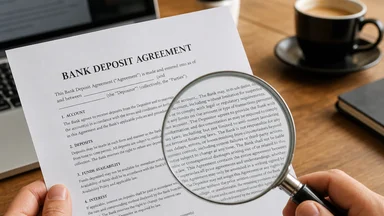
Standard deposit agreements from major U.S. banks include language like: "We may terminate this agreement and close your account at any time, for any reason, without prior notice." The wording varies, but the effect is the same. The bank does not need to tell you why, and it does not need to give you time to move your money.
In practice, this means your paycheck can be deposited on Friday, and by Monday the account is frozen with no explanation. A small business that relies on daily cash flow can find its operating funds locked up for weeks while the bank conducts an internal review. The bank typically returns the funds eventually, minus any fees, but the damage—missed payroll, bounced checks, late vendor payments—is already done.
The justification banks give is regulatory compliance. Federal anti-money laundering (AML) rules require banks to monitor accounts for suspicious activity. If a bank fails to act on a red flag, it can face fines or enforcement actions. So banks err on the side of caution, closing accounts at the first hint of something unusual, even when the activity is benign.
A widely reported example came in 2024, when Citibank closed thousands of accounts in a single sweep, citing automated screening alerts. Many of the affected customers had no idea what triggered the closure. The bank later said it was refining its risk models, but account holders got no apology and no recourse.
Why Banks Are Closing Accounts More Often
The frequency of account closures has risen sharply since the mid-2010s, driven by three forces: stricter AML enforcement, false positives from Office of Foreign Assets Control (OFAC) screening, and the use of machine learning models that flag normal transactions as suspicious.
Under the Bank Secrecy Act, banks must file Suspicious Activity Reports (SARs) for transactions over $5,000 that appear unusual. But the definition of "unusual" is left to the bank's discretion. A cash deposit of $9,000 every two weeks—perfectly legal—can trigger an alert because it falls just under the $10,000 reporting threshold, a pattern known as structuring. The bank may decide the account is too risky to keep open.
OFAC screening software compares account holders against lists of sanctioned individuals and entities. False matches are common because the software uses fuzzy matching—a name similar to a sanctioned person's can trigger a hit. Clearing the false positive takes days or weeks, during which the account may be frozen. If the bank gets too many false positives from one customer, it may simply close the account to avoid future compliance headaches.
A 2025 study by the Consumer Financial Protection Bureau found that roughly one in twenty small business owners reported having a bank account closed involuntarily in the previous two years. The most common reason given was "unusual transaction pattern," a catch-all that can cover anything from rapid deposits to multiple international wire transfers.
The Atlantic Union Bank Enforcement Connection
In May 2026, the Federal Reserve Board issued enforcement actions against former employees of Atlantic Union Bank and Frost Bank for misconduct. The Atlantic Union case involved a former employee who allegedly misused customer information. While the action itself was about individual wrongdoing, it had a ripple effect on how the bank handles account risk.
After the enforcement action, Atlantic Union Bank tightened its internal controls, including the criteria for closing accounts deemed high-risk. The bank did not publicly announce the change, but customers began reporting account freezes on social media and in consumer complaints. The pattern was consistent: the bank would freeze the account, ask for documentation, then close it anyway, citing the deposit agreement's termination clause.
The Fed's action served as a warning to other banks: regulators are watching, and the cost of a compliance failure can be steep. In response, many banks have adopted a "better safe than sorry" approach, closing accounts that present even a moderate risk rather than investing time in manual review. The customer is left with no recourse, because the deposit agreement explicitly allows this.
The Atlantic Union case is not unique. Similar enforcement actions against other regional banks have led to the same outcome: tighter policies, more closures, and less transparency for account holders. The bank's priority is regulatory compliance, not customer service.
What the Deposit Agreement Really Says
The typical deposit agreement runs 20 to 30 pages. Key clauses to look for include the termination clause, the suspicious activity clause, and the arbitration clause. The termination clause usually states that the bank can close the account at any time, with or without cause, and with or without notice.
The suspicious activity clause gives the bank the right to freeze or close your account if it believes, in its sole discretion, that the account has been used for illegal or suspicious purposes. The agreement does not define what counts as suspicious. That ambiguity is intentional—it gives the bank maximum flexibility to act on any alert from its monitoring systems.
Many deposit agreements also include a waiver of state laws that would otherwise require notice before closing an account. For example, some states have laws that require banks to give 30 days' notice before closing a consumer account. The deposit agreement may explicitly override those laws by stating that federal regulations take precedence, or by simply including a clause that says the bank's rules supersede state law.
Finally, nearly all deposit agreements include a mandatory arbitration clause and a class action waiver. This means that if your account is closed and you suffer damages, you cannot sue the bank in court or join a class action. You must pursue individual arbitration, which is expensive and often not worth the time for the amount of money at stake. The result is that banks face almost no legal consequences for arbitrary closures.
Case Study: A Small Business Frozen Without Warning
Consider the case of a small online retailer that had been banking with a regional bank for three years. The business made roughly 12 deposits per month, ranging from a few hundred to a few thousand dollars. Transactions were mostly credit card payments processed through a payment gateway, with occasional wire transfers from suppliers.
In early 2026, the retailer received an email from the bank stating that the account had been frozen due to "unusual transaction patterns." No further explanation was given. The retailer's payroll was scheduled for the next day. Checks started bouncing, and two employees missed their paychecks. The retailer called the bank repeatedly but got only automated messages saying the matter was under review.
After 60 days, the bank sent a check for the account balance, minus a $50 account closure fee and a $100 research fee. No apology, no explanation of what triggered the freeze. The retailer later learned from a bank employee that the trigger was a series of wire transfers from a supplier in a country that OFAC had flagged for sanctions risk—even though the supplier was not on any sanctions list.
The retailer's experience is typical. The bank's systems flagged a legitimate transaction, the bank froze the account without human review, and the customer paid the price. The deposit agreement allowed it all. The only way to prevent such a scenario is to have a backup account at a different bank—something the retailer now does.
How to Protect Yourself From Arbitrary Closure
There is no way to guarantee your account won't be closed, but you can reduce the odds. The most important step is to maintain accounts at two different banks. That way, if one account is frozen, you still have access to funds. This is especially critical for small businesses that need daily access to cash.
Avoid frequent cash deposits just under $10,000. While such deposits are legal, they can trigger structuring alerts. If you routinely deposit large amounts of cash, consider talking to your bank in advance to explain the pattern. Some banks will note your account to reduce false alerts, though this is not guaranteed.
Document all your business transactions. Keep invoices, contracts, and receipts for any large or unusual payments. If your account is frozen, you may need to provide this documentation to the bank to prove the transactions are legitimate. The faster you can respond, the shorter the freeze may last.
Read the deposit agreement before you sign. Look for the termination clause, the suspicious activity clause, and the arbitration clause. If you are uncomfortable with the terms, consider a credit union or a community bank that may offer more local decision-making and less reliance on automated systems.
Finally, consider using a credit union instead of a bank. Credit unions are member-owned and often have more flexible policies. Their decision-making is typically local, so a freeze is more likely to involve a human review rather than an automated trigger.
Trade-Offs: The Bank's Perspective
While account closures are frustrating for customers, it is worth understanding the bank's side. Banks face enormous regulatory pressure. The Bank Secrecy Act and anti-money laundering rules impose heavy fines for non-compliance. In 2023, the Department of the Treasury assessed over $5 billion in penalties against financial institutions for AML violations. To avoid such penalties, banks invest heavily in compliance systems.
Automated screening is a cost-effective way to monitor millions of transactions. But it produces false positives. A bank could manually review every alert, but that would require hiring thousands of additional compliance officers, increasing costs that would be passed on to customers. The trade-off is between accuracy and cost. Most banks choose cost efficiency, accepting that some legitimate accounts will be closed.
Another trade-off involves speed. When a suspicious transaction is detected, the bank must act quickly to prevent potential money laundering. A manual review might take days, during which illicit funds could be moved. Freezing the account immediately is the safest regulatory move. The customer suffers, but the bank protects itself from regulatory action.
Some argue that banks could improve communication. For example, a bank could send a warning notice before freezing an account, giving the customer a chance to explain. But banks worry that such a notice could tip off someone engaged in illegal activity, allowing them to move funds before the freeze. The result is a system that prioritizes security over customer experience.
There is also a competitive angle. Banks that are too aggressive in closing accounts may lose customers to more lenient institutions. But so far, the major banks have not seen significant customer exodus, partly because closures are still relatively rare and partly because customers have few alternatives. Community banks and credit unions are often more flexible, but they may lack the technology to offer the same services.
Counter-Arguments: Is This Really a Problem?
Not everyone agrees that arbitrary account closures are a widespread issue. Bank industry groups argue that the number of closures is small relative to the total number of accounts. They point out that the vast majority of customers never experience a freeze, and that banks have a legitimate interest in preventing financial crime.
Some consumer advocates counter that even a small number of closures can have devastating effects on those affected. A small business that loses access to its operating funds can fail. An individual whose account is frozen may be unable to pay rent or buy groceries. The asymmetry of power between bank and customer is the core issue.
Another counter-argument is that customers can always take their business elsewhere. But switching banks is not easy. It involves updating direct deposits, automatic payments, and linked accounts. For a small business, the disruption can be significant. Moreover, if a bank closes your account, it may report you to ChexSystems, a consumer reporting agency that tracks account abuse. A negative report can make it difficult to open an account at another bank for years.
The debate ultimately comes down to priorities. Banks prioritize regulatory compliance and cost control. Customers prioritize reliability and fairness. The deposit agreement, as currently written, gives banks the upper hand. Until regulators or lawmakers address the imbalance, customers must protect themselves.
The Revisionist Take: Your Bank Is Not Your Ally
The conventional wisdom says to build a relationship with your bank, consolidate your accounts, and become a valued customer. The revisionist take is that this advice is outdated. From the bank's perspective, a deposit account is a liability, not an asset. The bank pays you interest (if any) and incurs costs to manage the account. It keeps your money only because it can lend it out at a higher rate.
When regulatory risk enters the picture, the bank's incentive shifts. A single account that generates a suspicious activity report costs the bank time and money to file. If the account is closed, that cost disappears. The bank has no loyalty to you as a customer, because your deposit is small compared to its overall funding base. The term "relationship banking" is mostly marketing.
The practical advice is to treat your checking account as a disposable tool, not a long-term relationship. Keep the minimum balance required to avoid fees. Use a separate bank for savings if you want a backup. And always have a second account at a different institution, ready to go if the first one is closed.
This may sound cynical, but it is grounded in the reality of the deposit agreement you signed. The bank can close your account without notice, and it will do so if its automated systems flag you. Your best defense is not to rely on any single bank.
This article is for informational purposes only and does not constitute legal or financial advice. Consult a qualified professional for guidance specific to your situation.