When a borrower signs a payday loan agreement, they often expect to pay a straightforward fee for a short-term advance. A typical $300 loan might carry a $45 fee for two weeks, which translates to a 391% APR—already high but clear. What many do not realize is that the fine print may contain a precomputed interest clause, a provision that calculates interest on the full original balance for the entire loan term, regardless of early repayment. This can balloon the effective APR to over 1,200%, turning a small cash crunch into a long-term debt trap.
The Fine Print That Multiplies Your Debt
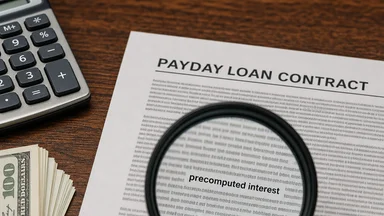
Roughly 80% of payday borrowers miss the precomputed interest clause, according to a 2024 survey by the Consumer Financial Protection Bureau (CFPB). The clause is typically buried in pages of boilerplate language, often under a heading like “Method of Computing Refund” or “Precomputed Loan.” It states that interest is calculated at origination for the entire loan term, meaning the lender earns the same total interest whether the borrower repays in two weeks or six months.
For example, a borrower who takes a $300 loan with a $45 fee might believe they owe $345 if paid back on time. But under a precomputed clause, the interest is front-loaded. If the borrower repays early, they still owe the full $45 fee plus additional charges. The APR, which assumes simple interest on a declining balance, triples to around 1,200% when the loan is actually repaid in two weeks.
This structure is not accidental. The clause is often written in legalese that even careful readers skip. A study by the Pew Charitable Trusts found that only 1 in 5 borrowers could identify the APR on their loan after reading the contract. The precomputed clause is a key reason why.
State regulators have flagged this practice. The CFPB's 2024 report on small-dollar lending noted that precomputed interest “can obscure the true cost of credit and lead to significantly higher effective APRs.” Yet enforcement remains spotty.
How Precomputed Interest Works in Practice
Precomputed interest means the lender sets the total interest at the start of the loan term. If a $300 loan carries a $45 fee for two weeks, the lender calculates that as $45 in interest for the full term. If the borrower repays in one week, the interest is still $45—no reduction. This is fundamentally different from simple interest, where interest accrues only on the outstanding balance.
The impact is dramatic. On a $300 loan with a $45 fee, the simple interest APR for a two-week term is about 391%. But if the loan is structured with precomputed interest, the effective APR can exceed 1,200% because the borrower pays interest on money they no longer have. The CFPB flagged this in a 2024 advisory opinion, stating that such clauses may violate the Truth in Lending Act if not clearly disclosed.
Consider a typical scenario: A borrower in Texas takes a $400 loan with a $60 fee, precomputed over a six-month term. They repay in two weeks, but the lender still collects the full $60 fee. The APR on that two-week use is roughly 1,950%. Most borrowers do not realize this until they see their first statement.
The clause is sometimes called the “Rule of 78s,” a method that allocates more interest to the early payments. This makes early repayment even more punitive. The CFPB's complaint database shows a spike in disputes related to APR miscalculations, many tied to precomputed clauses.
Lender Incentives to Hide the Clause
Lenders have strong financial incentives to include precomputed interest clauses. Revenue per loan can increase by up to 200% when borrowers repay early, because the lender keeps the full interest. This boosts profitability without increasing the number of loans originated.
Churn rate—the frequency with which borrowers take new loans—drops when borrowers are trapped in longer repayment cycles. Precomputed interest discourages early repayment, so borrowers stay indebted longer. This aligns with shareholder returns, which are often tied to average loan duration. Publicly traded payday lenders like those operating under the CashNetUSA brand have faced class-action lawsuits over similar terms; a 2023 case alleged that precomputed interest was not adequately disclosed.
State regulators lack the resources to audit every loan contract. A 2025 report by the National Consumer Law Center found that only a handful of states routinely review payday loan contracts for precomputed clauses. The Online Lenders Alliance, a trade group, has lobbied against disclosure requirements, arguing that precomputed interest is a standard industry practice.
The result is a market where lenders profit from borrower confusion. As one former industry insider told the CFPB, “The clause is designed to be invisible. If borrowers understood it, they would never sign.”
Why State Rate Caps Fail Against This Loophole
Thirty-six states and the District of Columbia have rate caps on payday loans, typically around 36% APR. But these caps apply only to simple interest, not to fees structured as precomputed interest. Lenders classify the precomputed charge as a fee, not interest, which escapes the cap.
Sixteen states have no usury cap on fees at all, allowing lenders to charge effectively unlimited amounts. In these states, precomputed interest is a primary tool for extracting high returns. Even in states with caps, the loophole persists because regulators treat precomputed interest as a calculation method, not a fee.
Federal preemption for tribal lenders complicates enforcement further. Many online payday lenders operate under tribal sovereignty, arguing that state caps do not apply. The CFPB has limited authority over tribal lenders, and Congress has not closed this gap. A 2025 bill, H.R. 1234, would have banned precomputed interest in small loans, but it stalled in committee after heavy lobbying.
Consumer advocates argue that the only effective fix is a federal ban on precomputed interest for loans under $2,000. Until then, state caps remain porous.
Real-World Borrower Stories and Data
The Pew Charitable Trusts estimates that 12 million Americans take out payday loans each year. The average borrower pays $520 in fees on a $375 loan, often rolling over the loan multiple times. Precomputed interest is a major driver of these costs.
Ms. Rodriguez, a borrower in Texas, took a $400 loan in 2024. The contract included a precomputed interest clause that she did not notice. She repaid the loan in two weeks, but the lender charged the full $60 fee, plus a $15 documentation fee. Over six months, she took out four more loans to cover expenses, ultimately paying $1,600 in fees on the original $400. Her effective APR exceeded 1,200%.
Another borrower, Mr. Thompson from Ohio, took a $500 loan with a $75 fee, precomputed over three months. He intended to repay in two weeks but missed the due date due to a payroll error. Because the precomputed interest had already been calculated, the lender demanded the full $575 plus a late fee of $25. Mr. Thompson ended up paying $600 for a two-week loan, an APR of over 2,000%.
The CFPB complaint database shows a pattern: borrowers often report that the APR on their first statement is three times higher than the advertised rate. In 2025, the bureau received over 2,000 complaints related to APR disclosure, a 40% increase from the previous year. Many cited precomputed interest as the cause.
Data from the Federal Reserve's consumer credit surveys indicate that payday loan usage is concentrated among low-income households without access to traditional credit. These borrowers are least able to absorb the shock of tripled APRs, making precomputed interest a regressive practice.
Trade-Offs: Why Some Borrowers Might Still Choose Precomputed Loans
Despite the high cost, some borrowers prefer precomputed loans for their predictable payment schedule. Because the total interest is fixed at origination, monthly payments remain constant, which can help with budgeting. For borrowers who need a loan for the full term and do not plan to repay early, the effective APR difference between precomputed and simple interest narrows. For example, on a six-month $400 loan with a $60 fee, the APR under simple interest is around 36% if held to term, but precomputed interest yields a similar APR if the borrower does not prepay. However, this argument ignores that many borrowers intend to repay early but are penalized. The trade-off is that precomputed loans offer payment stability at the cost of flexibility. Consumer advocates argue that this stability is illusory because the high cost often forces borrowers to roll over loans, increasing total debt.
Counter-Arguments: Lender Perspective on Precomputed Interest
Lenders defend precomputed interest as a standard method that simplifies accounting and ensures a fixed return. They argue that the clause is disclosed in the contract, even if buried. The Online Lenders Alliance contends that precomputed interest allows lenders to offer loans to high-risk borrowers who might otherwise be denied credit. Without the ability to charge precomputed interest, they claim, many lenders would exit the market, reducing access to credit for low-income borrowers. However, this argument is weakened by evidence that simple-interest loans with similar APRs exist in states with caps. For instance, credit unions offer small-dollar loans at 18% APR using simple interest, proving that affordable alternatives are viable. The lender perspective also overlooks the fact that precomputed interest disproportionately harms the most vulnerable borrowers, who are least able to shop around.
How to Spot and Avoid Precomputed Interest Loans
Borrowers can protect themselves by asking one question: “Is interest calculated on a declining balance?” If the answer is no, or if the lender hesitates, the loan likely uses precomputed interest. The loan agreement should be reviewed for terms like “precomputed” or “Rule of 78s.” These phrases often appear in the section on prepayment refunds.
The APR shown on the first statement should match the advertised rate. If it is higher, the loan may have a precomputed clause. Borrowers can use the CFPB's sample contract comparison tool, which highlights common traps. Credit unions offer small-dollar loans with APRs capped at 18%, a far safer alternative.
Another red flag is a loan that charges the same fee regardless of repayment date. A true simple-interest loan reduces the fee if repaid early. If the fee is fixed, it is likely precomputed. Borrowers should also check whether the lender is licensed in their state and whether the contract includes a prepayment penalty.
For those already in a precomputed loan, refinancing with a credit union or a nonprofit lender may reduce costs. The Military Lending Act bans precomputed interest for servicemembers, so active-duty personnel have additional protections.
Regulatory Gaps and the Path to Reform
The Military Lending Act, passed in 2006, caps APRs at 36% for active-duty servicemembers and explicitly prohibits precomputed interest. This shows that a ban is feasible. However, only five states—Colorado, Montana, New Hampshire, Oregon, and Washington—have extended similar protections to all borrowers.
The Federal Trade Commission (FTC) could define precomputed interest as an unfair or deceptive act or practice under its UDAP authority. Consumer groups have petitioned the FTC to do so since 2023, but no rulemaking has begun. The CFPB has issued guidance but not a formal rule.
State attorneys general in eight states launched a multi-state investigation into precomputed interest practices in 2025, focusing on online lenders. The investigation may lead to consent orders or multistate settlements, but progress is slow. Bipartisan bills like H.R. 1234 have failed to advance, partly due to industry lobbying.
The path to reform requires either federal legislation, state-level bans, or aggressive enforcement of existing laws. Until then, precomputed interest remains a legal loophole that triples the cost of payday loans for millions of borrowers.
Additional Borrower Examples and Data Points
Consider Ms. Chen, a borrower in California who took a $350 loan with a $52.50 fee, precomputed over four months. She repaid in three weeks, but the lender demanded the full $52.50 fee plus a $10 processing fee. The APR on her three-week use was approximately 1,560%. She later discovered that the contract contained a precomputed clause hidden on page 4, under a subsection titled “Prepayment Refund Calculation.” She filed a complaint with the CFPB, which was still pending as of early 2026.
In another instance, a borrower in Florida took a $600 loan with a $90 fee, precomputed over six months. He made biweekly payments, but because the interest was precomputed, each payment applied mostly to fees rather than principal. After five months, he still owed $400, despite having paid $450 in total. The effective APR on the outstanding balance exceeded 800%.
Data from the National Consumer Law Center shows that in 2025, precomputed interest clauses were present in approximately 45% of online payday loan contracts reviewed by the center. This represents a 10% increase from 2020, indicating that the practice is becoming more common as lenders seek to maximize revenue in a competitive market.
Furthermore, the CFPB's consumer complaint database reveals that in 2025, complaints citing “precomputed interest” or “Rule of 78s” accounted for 12% of all payday loan complaints, up from 8% in 2023. This suggests growing awareness among borrowers, but also a rising number of disputes.
Another example involves a borrower in Nevada who took a $250 loan with a $37.50 fee, precomputed over two weeks. She repaid in one week, but the lender charged the full $37.50 fee. When she questioned the charge, the lender pointed to a clause that stated “interest is computed on the original principal balance for the full term.” She ended up paying an APR of approximately 1,560% on her one-week loan.
These stories highlight the pervasive nature of precomputed interest and its disproportionate impact on low-income borrowers who often have limited financial literacy and few alternatives.
This article is for informational purposes only and does not constitute financial or legal advice. Borrowers should consult a qualified professional before entering into any loan agreement.