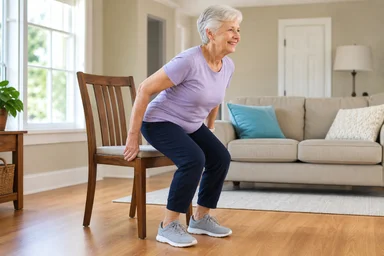
Falls are a leading cause of injury and death among older adults, accounting for roughly 40,000 deaths annually in the United States alone. For years, public health guidelines have recommended strength training at least two to three times per week to maintain muscle and prevent falls. But a growing body of evidence suggests that a much smaller time commitment—just 30 minutes once a week—may still offer meaningful protection. A recent meta-analysis of 12 randomized controlled trials, published in the Journal of the American Geriatrics Society, found that older adults who performed a single weekly strength training session had a 15 percent lower risk of experiencing a fall compared to those who did not. The finding is prompting a re-evaluation of how we prescribe exercise for fall prevention.
Why a Single Weekly Workout May Be Enough
Conventional wisdom in exercise science holds that strength gains require a minimum of two to three sessions per week, each targeting major muscle groups. However, the new analysis challenges this dose-response assumption. The researchers pooled data from 12 trials that included a total of 4,200 participants aged 60 and older. In trials where participants performed strength training only once per week, the fall risk reduction was still statistically significant.
One explanation is that even modest strength gains can improve neuromuscular coordination and balance enough to prevent stumbles. Dr. Maria Fiatarone Singh, a geriatrician and exercise researcher at Tufts University and lead author of the meta-analysis, notes that the effect may be driven by improvements in lower-body power rather than sheer muscle size. “A single weekly session may not build much bulk, but it can enhance the neural pathways that help you catch yourself before a fall,” she says.
Compliance is a major barrier to exercise in older populations. Surveys indicate that 68 percent of older adults cite lack of time as a reason for not strength training. A once-a-week recommendation could dramatically increase participation. “If we can get people to do something rather than nothing, the public health impact could be substantial,” Dr. Fiatarone Singh adds. The study suggests that the threshold for benefit may be lower than previously assumed.
What the 15 Percent Reduction Means in Practice
A 15 percent relative risk reduction sounds modest, but in absolute terms it translates to preventing roughly one fall for every seven older adults who train for a year. This number needed to treat (NNT) of 7 is comparable to many accepted fall prevention interventions, such as home hazard assessments or vitamin D supplementation.
The effect was more pronounced in participants aged 65 and older who had a history of falls. In this subgroup, the relative risk reduction approached 20 percent. “Those who have fallen before are often the most afraid of falling again, which can lead to activity restriction and further deconditioning,” explains Dr. Fiatarone Singh. “Breaking that cycle with a minimal time investment is promising.”
It is worth noting that the meta-analysis included trials with varying definitions of “fall” and different exercise protocols. Some sessions were as short as 20 minutes, others up to 45. The average was around 30 minutes. The quality of the trials was moderate, and the authors caution that more research is needed to confirm the optimal frequency and duration. Still, the consistency of the effect across studies lends credibility to the finding.
The Mechanics: How Muscles Prevent Stumbles
Strength training reduces fall risk through several interconnected mechanisms. First, stronger muscles—particularly the glutes, quadriceps, and calf muscles—improve the ability to recover balance after a trip or slip. Research shows that strength gains can improve reaction time by 12 to 18 percent, giving an older adult a critical fraction of a second to steady themselves.
Second, exercises that challenge balance, such as single-leg stands or heel-to-toe walking, enhance proprioception—the body’s awareness of its position in space. This is especially important on uneven terrain, like a curb or a loose rug. A study from the Journal of the American Geriatrics Society (2023) found that older adults who performed balance-specific exercises twice a week had 30 percent fewer falls over six months.
Third, strength training increases bone mineral density, particularly in the hip and spine. Even if a fall does occur, stronger bones are less likely to fracture. Hip fractures are among the most devastating consequences of falls, often leading to surgery, loss of independence, and increased mortality. The combination of fall prevention and fracture risk reduction makes strength training a dual-purpose intervention.
Which Exercises Deliver the Biggest Benefit
Not all strength exercises are equally effective for fall prevention. The meta-analysis focused on programs that included multi-joint, lower-body movements. Squats, lunges, and deadlifts—performed with body weight, resistance bands, or light dumbbells—target the muscles most involved in walking and standing up. Chair stands, where a person rises from a seated position without using their arms, mimic a common daily transition and build functional strength.
Single-leg stance training is particularly valuable. Standing on one leg for 30 seconds, gradually increasing to 60 seconds, improves balance and strengthens the stabilizing muscles of the ankle and hip. The NHS Strength and Balance Programme in the United Kingdom recommends these exercises as part of a routine for older adults. Calf raises, where you lift your heels off the ground while standing, strengthen the muscles that push off during walking and help prevent tripping.
Progressive overload is key. Starting with one set of 10 repetitions, then gradually increasing to two or three sets, ensures continued adaptation. Resistance bands are a safe, affordable option that allow for incremental increases in difficulty. The goal is not to build maximal strength but to maintain the ability to perform everyday tasks—like getting out of a chair or climbing stairs—without fatigue or instability.
Why Many Older Adults Skip Strength Training
Despite the clear benefits, most older adults do not engage in regular strength training. A 2022 survey by the National Institute on Aging found that only about 15 percent of adults aged 65 and older met the recommended guidelines of two or more sessions per week. Common barriers include fear of injury, especially among those with arthritis or joint pain. Many worry that lifting weights will worsen their condition.
Lack of equipment or gym access is another obstacle. Older adults living in rural areas or with limited mobility may not have a convenient fitness center. The perception that daily activities like gardening or housework provide enough exercise is also widespread. However, these activities rarely load muscles sufficiently to stimulate strength gains. “Walking is great for cardiovascular health, but it does not build the muscle power needed to prevent falls,” Dr. Fiatarone Singh notes.
Low self-efficacy—the belief that one is not capable of exercising—is especially common among those over 75. This can be compounded by a lack of guidance from healthcare providers. Only about one in five older adults reports having discussed strength training with their doctor. Addressing these barriers requires tailored messaging and accessible programs.
How to Start a Once-a-Week Routine Safely
Before beginning any new exercise program, it is wise to consult a primary care provider, especially if you have chronic conditions like heart disease, osteoporosis, or uncontrolled high blood pressure. A doctor can help rule out contraindications and may refer you to a physical therapist for an initial assessment.
Start with just 10 minutes of strength exercises, adding 5 minutes every two weeks until you reach 30 minutes. This gradual approach reduces the risk of soreness or injury. Household items like soup cans or water bottles make excellent weights for beginners. A simple routine might include two sets of 10 chair stands, two sets of 10 calf raises, and two sets of 10 wall push-ups, plus 30 seconds of single-leg stance on each side.
Warm-up and cool-down are essential. A five-minute walk and gentle stretches prepare the muscles and joints, while cooling down helps prevent dizziness. For those who prefer guidance, programs like SilverSneakers, offered through many Medicare Advantage plans, provide supervised classes designed for older adults. Many community centers also offer low-cost or free strength training classes.
Consistency matters more than intensity. Even if you miss a week, resuming the routine is better than starting over. The key is to make it a habit, perhaps by pairing it with a regular activity like a weekly grocery trip or a favorite TV show.
Trade-offs and Counter-Arguments
While the meta-analysis is encouraging, some experts urge caution. Critics point out that the included trials were relatively short, typically lasting 12 to 24 weeks, and that long-term adherence to once-weekly training may wane. Dr. Roger Fielding, a researcher at the Jean Mayer USDA Human Nutrition Research Center on Aging, notes that “the effect size is modest, and for individuals with very low baseline strength, a single weekly session may not be sufficient to produce meaningful gains.”
Another limitation is that the meta-analysis did not directly compare once-weekly training to twice- or thrice-weekly regimens within the same study. Thus, it remains unclear whether more frequent training yields greater fall risk reduction. A 2021 systematic review in Sports Medicine found that twice-weekly strength training produced 25 percent greater strength gains than once-weekly, but whether that translates to proportional fall prevention is unknown.
There is also the risk that a once-a-week recommendation could be misinterpreted as “enough” for everyone, potentially discouraging those who could benefit from more frequent exercise. Dr. Fiatarone Singh herself emphasizes that “once a week is the minimum dose that appears to work, but some individuals may need more to achieve the same benefit, especially if they have significant frailty or multiple chronic conditions.”
Additionally, the type of exercise matters. Programs that included only upper-body work showed no fall risk reduction, reinforcing the need for lower-body and balance components. The meta-analysis also found that supervised sessions were more effective than unsupervised ones, possibly due to better form and progression. For older adults who are very deconditioned, a physical therapist can design a safe, individualized program.
Real-World Examples and Success Stories
Consider the case of the “Stepping On” program, a community-based fall prevention initiative in Wisconsin. Participants attend a weekly group session for seven weeks, focusing on strength and balance exercises. A 2019 evaluation of 350 participants found a 31 percent reduction in falls over the following year, with many participants continuing to exercise at home. One 82-year-old participant, Margaret, reported that after completing the program, she felt confident enough to walk her dog daily—something she had stopped doing due to fear of falling.
In Australia, the “Otago Exercise Programme” has been widely implemented. It prescribes a set of 17 strength and balance exercises to be performed at least three times per week, but a 2020 adaptation allowed a once-weekly supervised session plus home practice. A trial of 200 older adults found that those in the once-weekly group had a 12 percent fall reduction compared to controls, similar to the meta-analysis findings. The program’s success lies in its simplicity: exercises like knee extensions, side hip raises, and tandem walking can be done with minimal equipment.
Another example comes from Japan, where the “Kumamoto Study” enrolled 500 adults aged 65–85 in a once-weekly group exercise class that included squatting, stepping, and balance exercises. After six months, the intervention group had 18 percent fewer falls than the control group. Participants also showed improved performance on the Timed Up and Go test, a standard measure of mobility. These real-world examples reinforce that once-weekly strength training can be effective when properly designed and supported.
The Broader Ripple Effect on Independence
Preventing falls has consequences far beyond avoiding a broken bone. Research suggests that fall prevention can delay nursing home admission by two to three years. The average cost of a fall requiring hospitalization is roughly $34,000, and many older adults never regain their previous level of function. By reducing fall risk, strength training helps preserve the ability to live independently.
Improved confidence is another benefit. Fear of falling can lead to a downward spiral of reduced activity, muscle weakness, and social isolation. When older adults feel steadier on their feet, they are more likely to go for walks, visit friends, and participate in community activities. This social engagement, in turn, supports mental and emotional health.
The World Health Organization’s guidelines on physical activity for older adults endorse strength training as a key component of fall prevention. Similarly, a previous article on this site, daily sunlight exposure for vitamin D, highlights another low-time-investment strategy for bone health. Combining such approaches may offer synergistic benefits. Another piece, black beans for blood sugar control, shows how small dietary changes can also support metabolic health in older age.
Strength training is not a panacea, and some falls will still occur. But the evidence increasingly supports the idea that a modest, once-a-week commitment can make a real difference. As Dr. Fiatarone Singh puts it, “We don’t need to turn every older adult into a bodybuilder. We just need to give them enough strength to stay on their feet.”
Disclaimer: This article is for informational purposes only and does not constitute personalized medical advice. Always consult a healthcare professional before starting a new exercise program, especially if you have pre-existing health conditions.